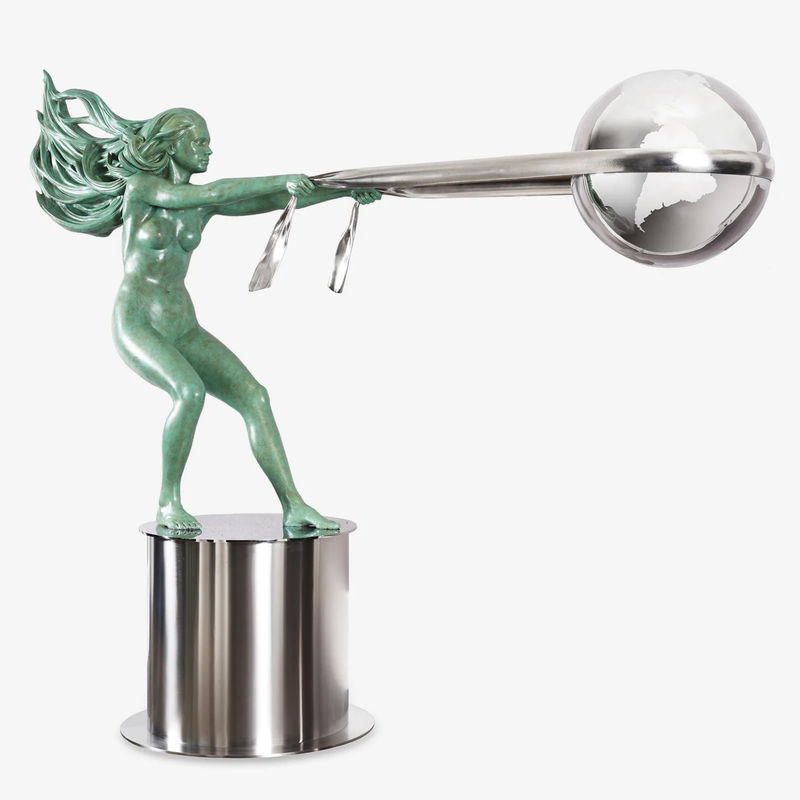
Lorenzo Quinn
Italian, b. 1966
For Quinn, sculpture is primarily an art of communication, a medium through which he aims to help people evolve further in tolerance, understanding and harmony. ‘I make art for myself and for people who wish to come along for a ride through my dreams’, he says. ‘How we live our own lives is of the utmost importance, and most of my work has to do with values and emotions.’
Born on 7 May 1966 in Rome to the Mexican-American actor Anthony Quinn[1] and his second wife, costume designer Iolanda Addolori, Lorenzo Quinn had a childhood split between Italy and the United States of America. His father had a profound influence on him, both in terms of living in the limelight of the film world and with respect to Anthony’s early work in painting and architecture.
Lorenzo Quinn studied at the American Academy of Fine Arts in New York, planning to be a Surrealist painter.[2] However, at 21 he decided that his future lay in sculpture, which could better accommodate his energy and originality. He vividly recalls the moment in 1989 when he felt that he had created his first genuine work of art: ‘I had made a torso from Michelangelo’s drawing of Adam ... an artisan’s job.... I had an idea and began chiselling away, and Eve came out of Adam’s body.... It had started as a purely academic exercise, yet it had become an artwork.’
In 1988 Quinn married Giovanna Cicutto, and on the birth of the first of their three sons they decided to leave New York – a place that ‘hardens your human values’ – and settle in Spain. ‘We chose Spain for its Latin character, its fervour ... the way it values people and family, and for its great artistic trajectory’, he comments.
In his twenties Quinn had a brief acting career, including playing alongside his father in Stradivari (1989)[3] and an acclaimed performance as Salvador Dalí.[4] However, he did not enjoy working in the profession and decided to concentrate purely on sculpture.
Among the artists whose influence Quinn cites are Michelangelo, Bernini and Rodin.[5] His creative ideas spark quickly into life: ‘The inspiration comes within a millisecond’, he says, as he is driven to sculpt by observing life’s everyday energy. Yet a finished project takes months to realise, and it has to carry clear meaning. Quinn usually conceives each work in writing, and the poetic text is ultimately displayed with the sculpture, as an integral part of the piece, not merely explanation.
Quinn's work appears in many private collections throughout the world and has been exhibited internationally during the past 20 years. Among his commissions is The Tree of Life, produced for the United Nations and issued by the organisation as a stamp in 1993. The following year the Vatican engaged him to sculpt the likeness of Saint Anthony for the Basilica del Santo in Padua, in commemoration of the 800th anniversary of the saint's birth; the sculpture was blessed by the pope in St Peter's Square, Rome, in front of a crowd of 35,000.
Quinn’s public art includes Encounters, a massive globe enclosing a pointing hand, which was unveiled in 2003 opposite the Museum of Modern Art in Palma de Mallorca, Spain. In Birmingham, his Tree of Life was erected outside St Martin’s Church in 2005 to commemorate those who died in the Second World War blitz on the city. Further works are on display at King Edward’s Wharf – Creation, Volare and Crossing a Millennium – with their characteristic focus on the hand, the human form and the circle.
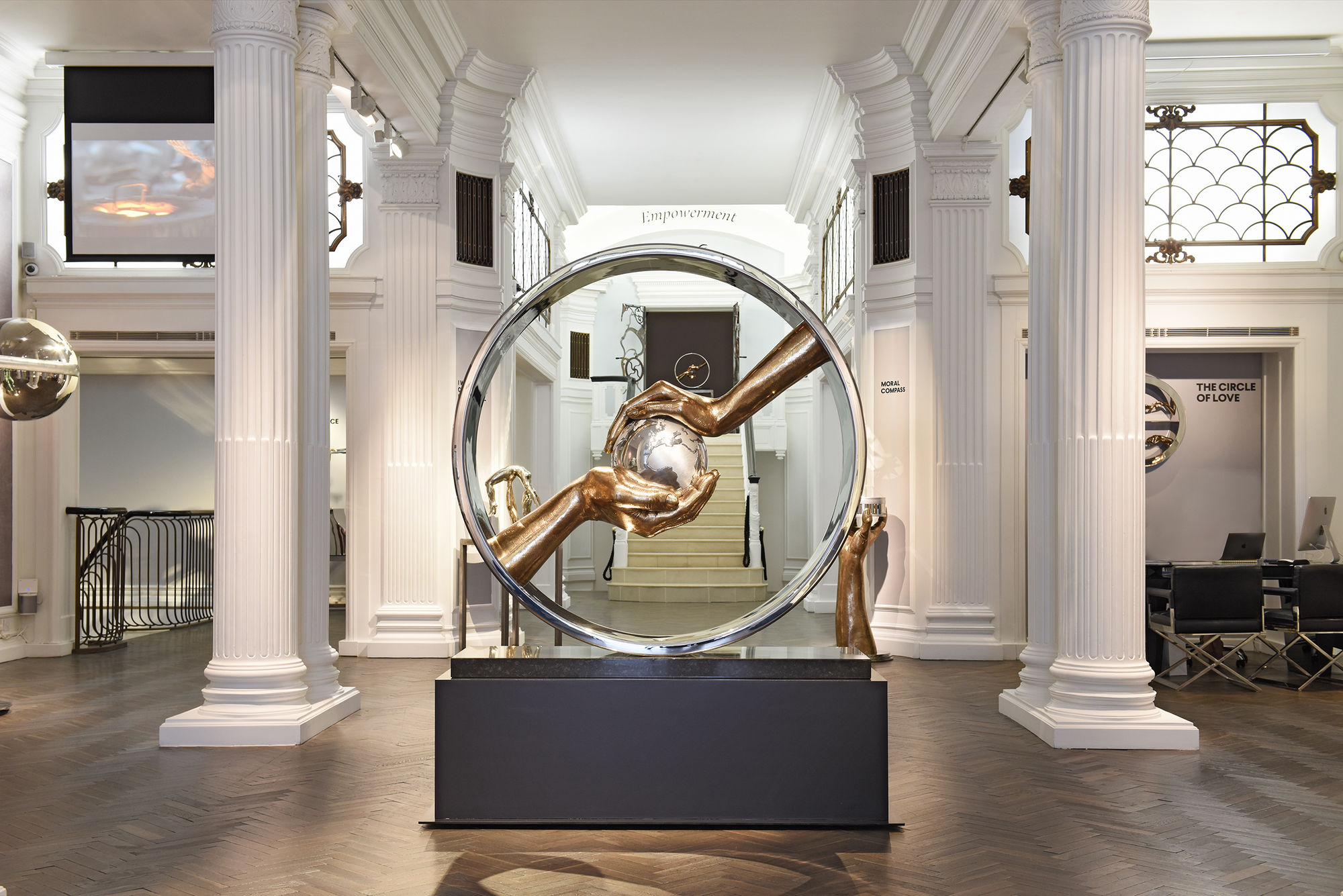
In November 2005 one of Quinn's largest public sculptures, Rise Through Education, was installed at ASPIRE, the Academy of Sports Excellence, in Doha, commissioned by the state of Qatar. Weighing an impressive 8,000 kilos, this monument shows a pair of adult hands placing the world in a child’s hand, the arms forming a circle above an open book. The artist’s commentary on the piece states: ‘A child is the most precious asset our future has. Our obligation is their guidance.... It is only through education and knowledge that a person may master his life.’ Quinn created a second sculpture for the interior of the academy to depict striving for excellence; Reaching for Gold is a pyramid of seven arms emerging from a base of sand, the hands straining towards a medal.
Unique among his works as a living monument, Legacy (2006) was sculpted for Sant Climent de Llobregat in Spain. Quinn was fascinated by the story of the town’s cherry trees and decided to make a piece that reflected this tale. The tree-trunk is formed by a male and a female hand holding branches laden with cherries arranged to simulate human DNA. In this area famed for its juicy cherries, the sculpture carries as many fruit as there are people living in Sant Climent; each year further cherries will be added to represent new inhabitants.
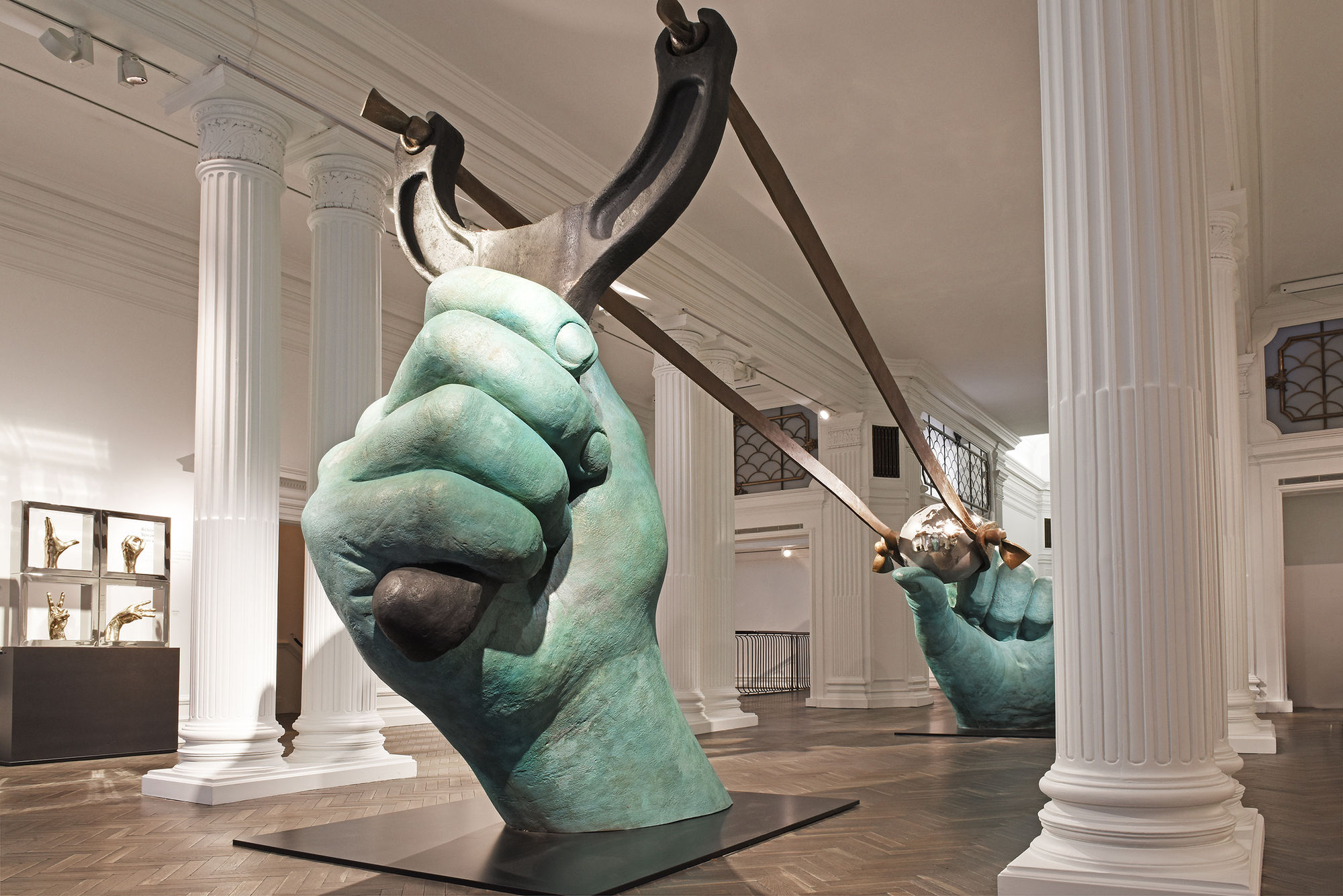
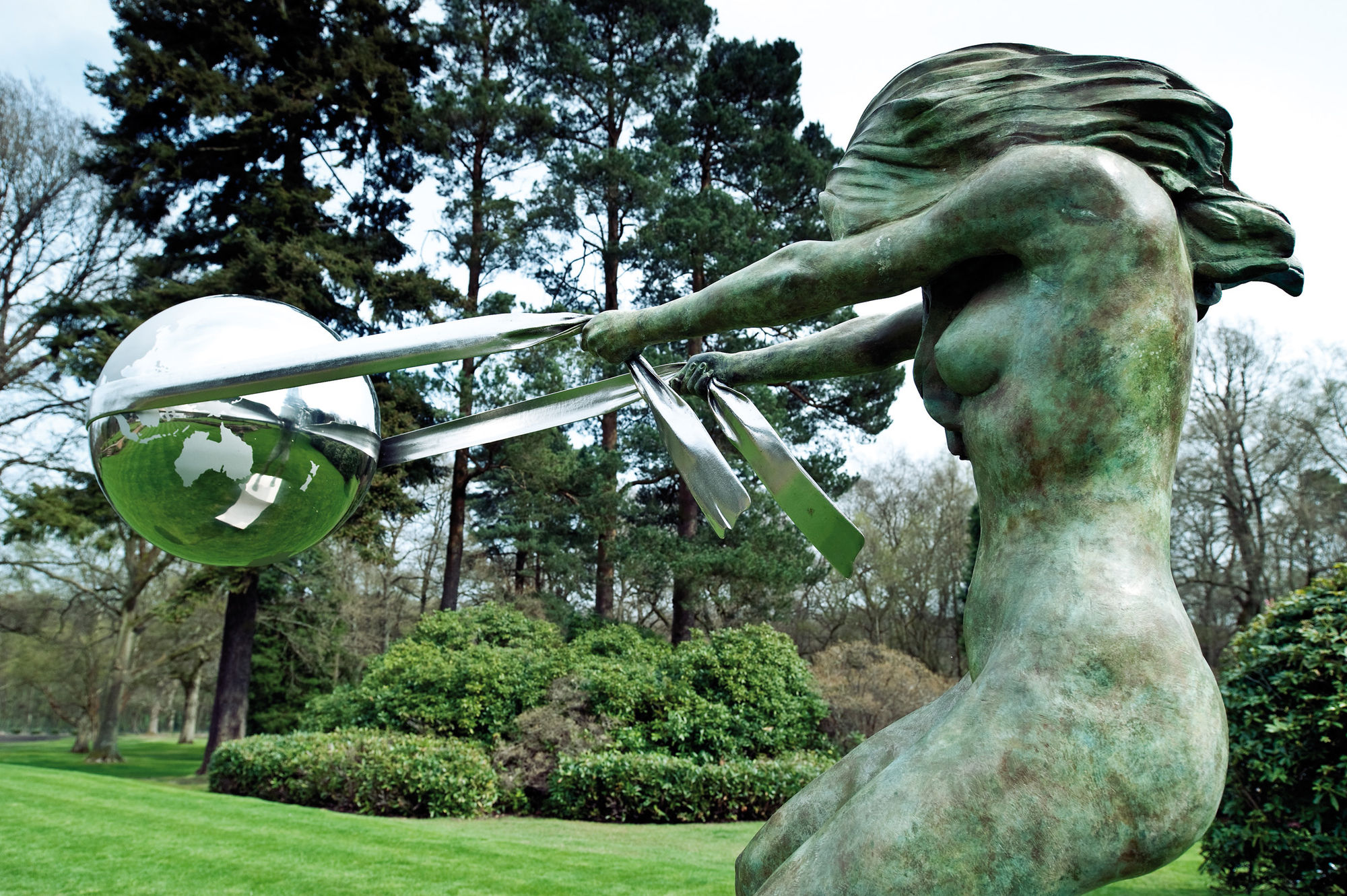
In 2008 Evolution, a major exhibition of Quinn’s output, was chosen to inaugurate the new premises of Halcyon Gallery in Mayfair, London, and the gallery published an important book on his work. Many of the sculptures in Evolution featured the symbol that has become synonymous with Quinn: the human hand. ‘I wanted to sculpt what is considered the hardest and most technically challenging part of the human body’, he explains. ‘The hand holds so much power – the power to love, to hate, to create, to destroy. I have injected a lifetime of experience into Evolution; it is about my past, present and future.’
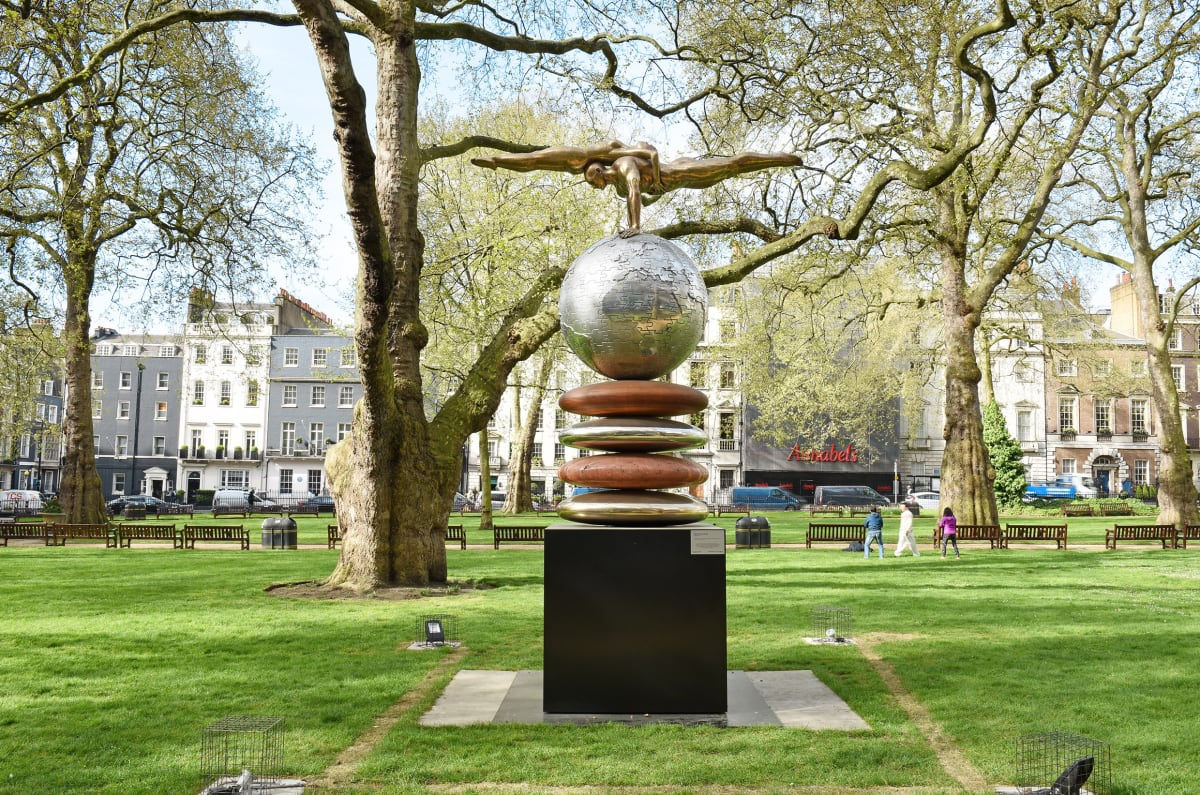
Equilibrium, an exhibition of Quinn’s monumental sculptures, followed in November 2009, coinciding with the installation of Give and Take III in Berkeley Square for six months. Included in the show were several important new sculptures, including What Came First? – male and female forms lying in egg-shaped hemispheres – and Home Sweet Home – a marble woman cocooned in barbed wire. The exhibition title reflects Quinn’s belief: ‘It is essential to find a balance in life. Many times that balance is achieved with the help of the people who surround us and hold us firmly to the ground, and without whom we would float into perdition.’
[1] Anthony Quinn (1915–2001) was a stage and screen actor famous for portraying rugged characters. On Broadway he played the lead in A Streetcar Named Desire (1952) and starred opposite Laurence Olivier in Becket (1960). For film roles in Viva Zapata! (1952) and Lust for Life (1956), the latter portraying French painter Paul Gauguin (1848–1903), he earned Oscars. Other acclaimed performances include the travelling showman in La Strada (1954) and the title role in Zorba the Greek (1964).
[2] A movement that flourished in Europe between the World Wars, Surrealism emerged as a reaction to the rationalism that had been the recent basis of European culture and politics. It involved reuniting the conscious and unconscious (the source of the imagination), bringing dream and fantasy into the everyday realm.
[3] Lorenzo Quinn played the young Antonio Stradivari and Anthony Quinn the same character in adult life; Stradivari (1644–1737) was one of the supreme violin makers of the late seventeenth and early eighteenth centuries, working in Cremona, Italy. Many believe that his instruments have never been surpassed.
[4] Lorenzo Quinn played the lead in Dalí (1990), directed by Antoni Ribas. Spanish painter, printmaker and sculptor Salvador Dalí (1904–1989), a leading figure in Surrealism in the 1930s, is best known for his images of melting watches in a dream world of sunlit landscapes.
[5] One of the supreme artists of the Italian High Renaissance, Michelangelo Buonarroti (1475–1564) was a painter, sculptor, architect and poet; Gianlorenzo Bernini (1598–1680) was a sculptor, painter and architect of the Italian Baroque. French artist François-Auguste-René Rodin (1840–1917) was the foremost sculptor of the nineteenth and early twentieth centuries, and possibly the greatest portraitist in the history of sculpture.