David Hockney and Normandy 'David Hockney: A Year in Normandie & Some Other Thoughts About Painting' opens at the Serpentine David Hockney and Normandy 'David Hockney: A Year in Normandie & Some Other Thoughts About Painting' opens at the Serpentine

David Hockney and Normandy

'David Hockney: A Year in Normandie & Some Other Thoughts About Painting' opens at the Serpentine
/

As David Hockney: A Year in Normandie and Some Other Thoughts About Painting opens at the Serpentine in London this Spring, we take a look at a period of tranquillity in the artist’s long career.

In 2019, after decades spent moving between California, Yorkshire and London, Hockney relocated to the small village of Beuvron-en-Auge in Normandy, northern France. Normandy brought with it new trees, blossoms and natural landscapes in which to find inspiration, as well as a reinvigorated commitment to looking intimately at the world around him.

If you are interested in adding to your collection speak to an art consultant today - info@halcyongallery.com
‘I know the views, I know the trees, I know them in winter, I’ve known them in summer, I’ve known them with their autumn leaves on. Each one, because that’s all I’m doing, looking at them.’
David Hockney
Having visited Normandy the previous year in 2018, Hockney relocated to a historic 17th century farmhouse named La Grande Cour...
David Hockney
In Front of House Looking West, 2019
Inkjet print on paper
86.4 x 109.2 cm

Having visited Normandy the previous year in 2018, Hockney relocated to a historic 17th century farmhouse named La Grande Cour with his two assistants. The rustic timber-framed house contained a shack with a cider press, which was renovated to include a small studio for the artist as he began to paint the sinuous branches of the bare winter trees. Winter soon gave way to spring, as blossoms and flowers adorned the landscape around the house.

Creating during this period as part of his My Normandy series, In Front of House Looking West is a scene of Hockney’s cottage and four-acre land. In the original ink drawing, he adopts the same vibrant linework and bold colour palette that he has used in his paintings and iPad drawings. The façade of the house and its red roof is contrasted sharply with the abundant greenery that encircles his home. In this domestic setting, Hockney meditates on place, time, light and the cycle of nature in his immediate surroundings. Paying particularly close attention to surfaces, colours, light and perspective, the cross-over between his painting techniques and digital works is ever-present. The act of sustained looking remains integral to this work and the wider My Normandy series. The same road, trees and house appear time and time again, repeated but never the same.

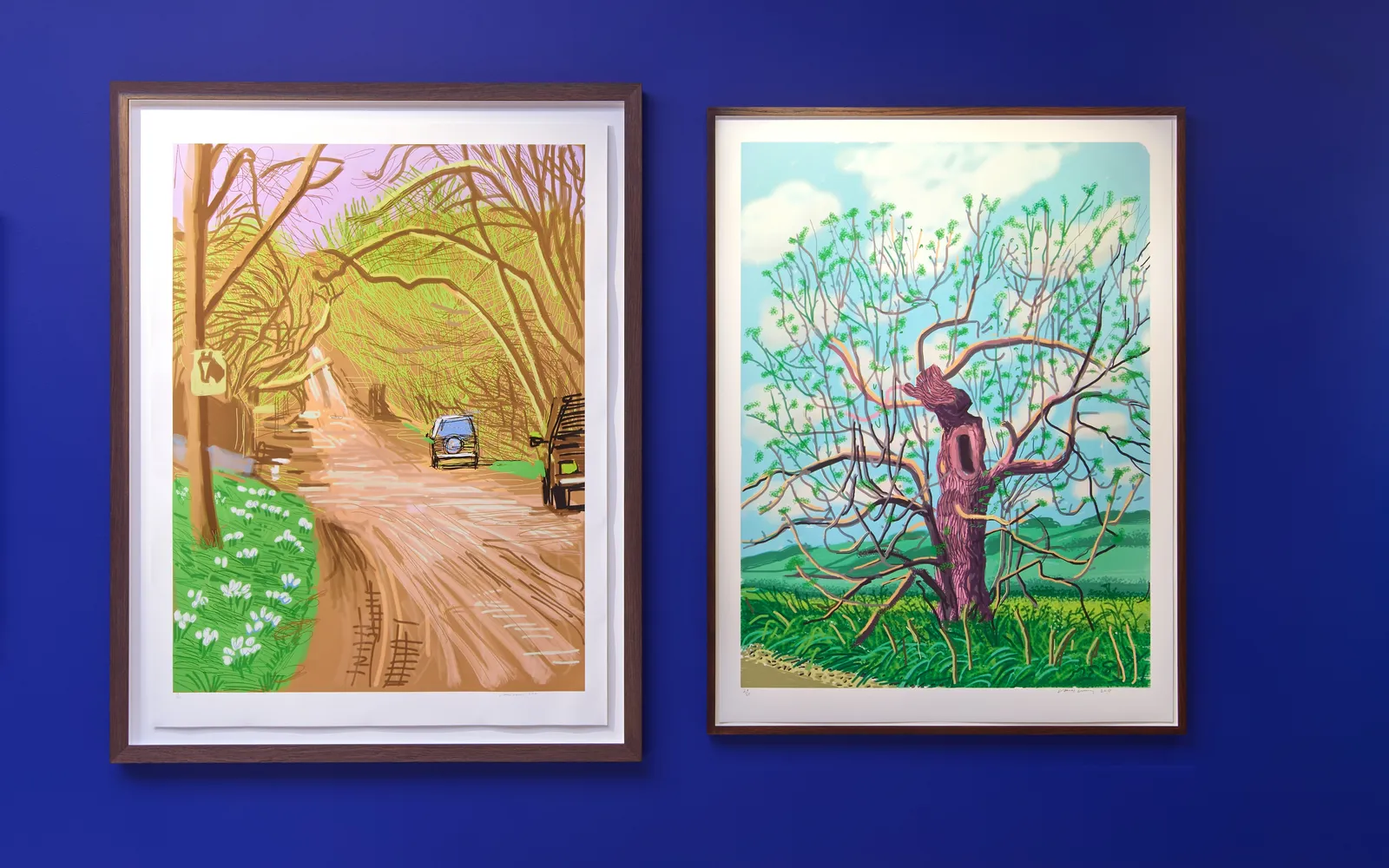
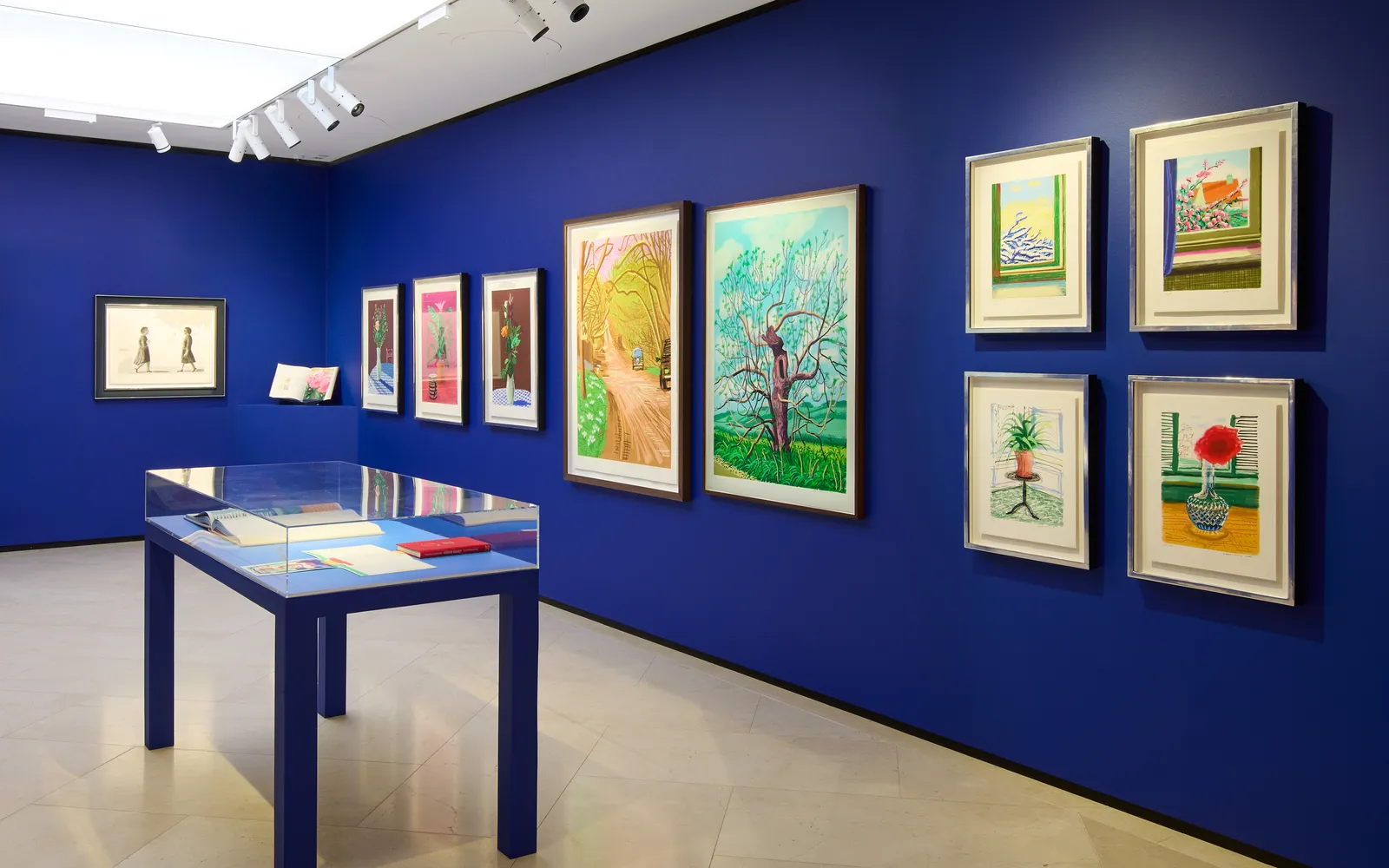
The emphasis on seasonal transformation connects My Normandy to the earlier series The Arrival of Spring in Woldgate, in Yorkshire. In both bodies of work, Hockney observes atmospheric cycles, capturing the subtle changes in season, mood and life inherent within the natural world. In Front of House Looking West and the Normandy works, however, offer an altogether more intimate view of Hockney’s domestic life and home. Confined to the peaceful environs of his house and its immediate landscape, much of Hockney’s time spent living in Normandy was marked by the COVID-19 lockdown, forcing him to look inwards and find inspiration in the everyday subjects that he found surrounding him.

‘These drawings … are testament to the cycle of life which begins here with the birth of spring.’
David Hockney
The perspective of In Front of House Looking West contains a foreground and middle ground, but is somewhat flattened and...
David Hockney
The Arrival of Spring in Woldgate, East Yorkshire, 18th May 2011, 2011
iPad drawing in colours, printed on wove paper
140 x 105.5 cm

The perspective of In Front of House Looking West contains a foreground and middle ground, but is somewhat flattened and appears to exist on the same pictorial plane. This approach reflects Hockney’s long-standing interest in alternatives to single-point perspective, a concern that has shaped much of his work since the 1970s. Rather than guiding the viewer’s eye towards a traditional, distant vanishing point, Hockney’s all-encompassing perspective encourages a continually roaming gaze. Just as the landscape that he sat down to draw was living and breathing, our eyes move across the surface of his image, noticing textures, colours and relationships between forms, never once settling on any particular element.

This interest in perspective and time is most prevalent in the 90-metre-long iPad frieze, A Year in Normandie (2020-2021), a monumental work on display for the first time in London at the Serpentine exhibition. Echoing Monet’s Water Lilies in its scale, and inspired by Chinese scroll paintings and the Bayeux Tapestry which will be loaned to the British Museum in 2026, A Year in Normandie combines more than 100 iPad drawings which together capture a panorama of the changing seasons. The conception of the work came when Hockney first moved into La Grande Cour in Normandy. His studio was not yet ready, and so the artist began to draw in a Japanese concertina sketchbook that he had bought in Amsterdam. The pages with their fold-out design allowed Hockney’s drawings to freely flow into one another, meaning that he could depict the temporally changing landscape from many different vantage points over time. Speaking in 2019 about finding inspiration in the Bayeux Tapestry, he said, ‘It covers about four years of time, so it is made like a Chinese scroll… The arrival of spring takes about six weeks in Normandy, so I intend to do it like a scroll. It’s a movie, but you do the moving.’

If you are interested in adding to your collection speak to an art consultant today - info@halcyongallery.com

DAVID HOCKNEY

DAVID HOCKNEY

    Atmospheric image Atmospheric image
    Atmospheric image Atmospheric image
    Atmospheric image Atmospheric image
    Atmospheric image Atmospheric image