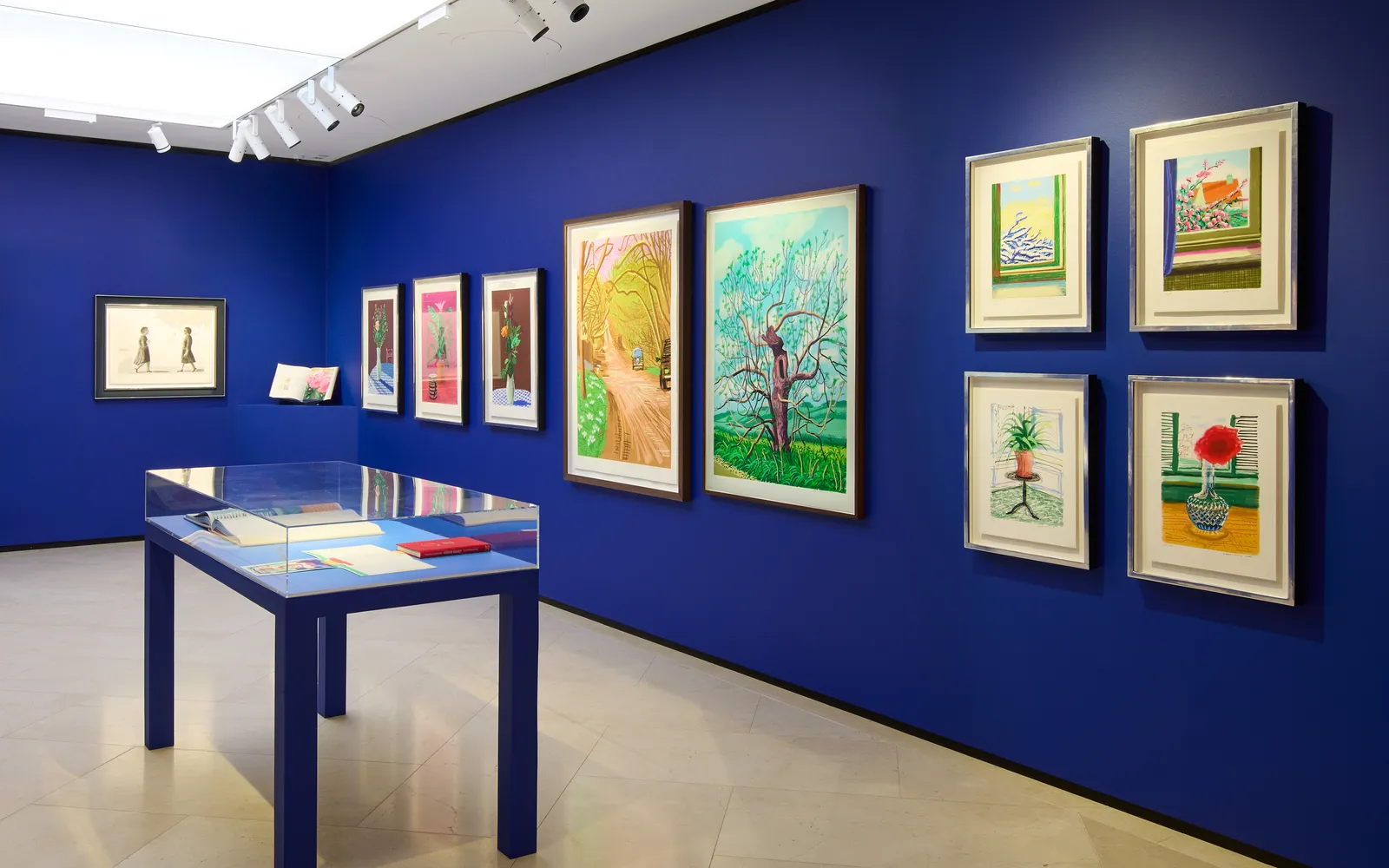
David Hockney: Normandy and New Perspectives 'Hockney: A Year in Normandie & Some Other Thoughts About Painting' opens at the... David Hockney: Normandy and New Perspectives 'Hockney: A Year in Normandie & Some Other Thoughts About Painting' opens at the...

David Hockney: Normandy and New Perspectives

'Hockney: A Year in Normandie & Some Other Thoughts About Painting' opens at the Serpentine, London
/

As David Hockney: A Year in Normandie and Some Other Thoughts About Painting opens at the Serpentine in London this spring, it offers an opportunity to reflect on a period of tranquillity and artistic innovation in the artist’s long career. Bringing together a large-scale iPad landscape, portraits and a group of experimental still life abstractions, the show centres on the body of work Hockney produced after relocating to rural Normandy in 2019.

In recent years, iPad drawing has become one of Hockney’s most important artistic mediums. Working on the device allows him to draw directly with colour and light in layers, producing images that retain the immediacy of sketching while also possessing the clarity and luminosity of a digital display. As Hockney’s primary medium in recent years, these digital works have featured prominently in major exhibitions, including David Hockney 25 at the Fondation Louis Vuitton in 2025, as well as in the current display at the Serpentine in London. The significance of these works has also been reflected in the market, as Sotheby’s recently held a landmark two-part sale dedicated entirely to 33 works from The Arrival of Spring in Woldgate series, achieving a total of £10.7 million. Together, these developments confirm the increasing recognition of the iPad drawings as a central element of Hockney’s late practice.

If you are interested in adding to your collection speak to an art consultant today - info@halcyongallery.com

Normandy
David Hockney
The Arrival of Spring in Woldgate, East Yorkshire, 18th May 2011, 2011
iPad drawing in colours, printed on wove paper
140 x 105.5 cm

Normandy

At the Serpentine, digital drawings form the foundation for A Year in Normandie (2020-2021), a monumental 90-metre-long iPad frieze that records the changing landscape surrounding Hockney’s home in northern France. The work is composed of more than one hundred individual iPad drawings which together capture a panorama of the changing seasons. Viewers are invited to walk alongside it and experience the gradual passage of time as winter branches give way to blossom and the vivid colours spring, summer and autumn are ushered in.

The origins of the work came when Hockney first moved to Normandy in 2019. After spending decades moving between Los Angeles, Yorkshire and London, the artist relocated to the picturesque village of Beuvron-en-Auge, to a historic 17th century farmhouse named La Grande Cour, with his two assistants. The rustic timber-framed house contained a shack with a cider press, which was renovated to include a small studio for the artist as he began to paint the sinuous branches of the bare winter trees. Surrounded by orchards and small country roads, the property offered a peaceful environment in which to observe the natural rhythms of the landscape. Winter soon gave way to spring, as blossoms and flowers adorned the landscape around the house.

When Hockney moved in, his studio was not yet ready, and so he began to draw in a Japanese concertina sketchbook that he had bought in Amsterdam. The fold-out design of the pages allowed Hockney’s drawings to freely flow into one another, meaning that he could depict the temporally changing landscape from many different vantage points over time. Conceptually, this attentiveness to time and transformation formed the basis of A Year in Normandie. Returning to the medium of the iPad for this work, Hockney was liberated by the device as it afforded him greater portability and allowed him to work en plein air in all weathers, recording the countryside not as a single image but as a sequence of moments unfolding over time. In doing so, he found direct inspiration in the 11th century Bayeux Tapestry, which he claims to have seen more than 20 times in the last three years. Speaking in 2019 about the tapestry’s influence, he said, ‘It covers about four years of time, so it is made like a Chinese scroll… The arrival of spring takes about six weeks in Normandy, so I intend to do it like a scroll. It’s a movie, but you do the moving.’

‘These drawings … are testament to the cycle of life which begins here with the birth of spring.’
David Hockney


Hockney’s works from Normandy are influenced by his earlier explorations of seasonal change, particularly The Arrival of Spring in Woldgate series (2011). Together, The Arrival of Spring and A Year in Normandie demonstrate Hockney’s fascination with the cyclical rhythms of nature and the subtle changes of the landscape over time. In The Arrival of Spring in Woldgate, East Yorkshire, 18th May 2011, Hockney captures the landscape in full bloom, with the bright yellow fields of rapeseed signalling late spring. This picture is a celebration of growth; the trunk of the tree is gnarled and bent, but Hockney depicts the precise moment in which its branches produce fresh buds. In this work, he demonstrates his skills in creating depth and layered perspectives by juxtaposing sharply defined lines with more diffused forms. The tree branches are crisp and defined, accentuated against the dappled fields, road and woodland that extends beyond. Rather than hiding the digital nature of these works, Hockney emphasises it, frequently using dots alongside fluid lines, employing the same stylistic techniques that can be found throughout his etchings and lithographs.
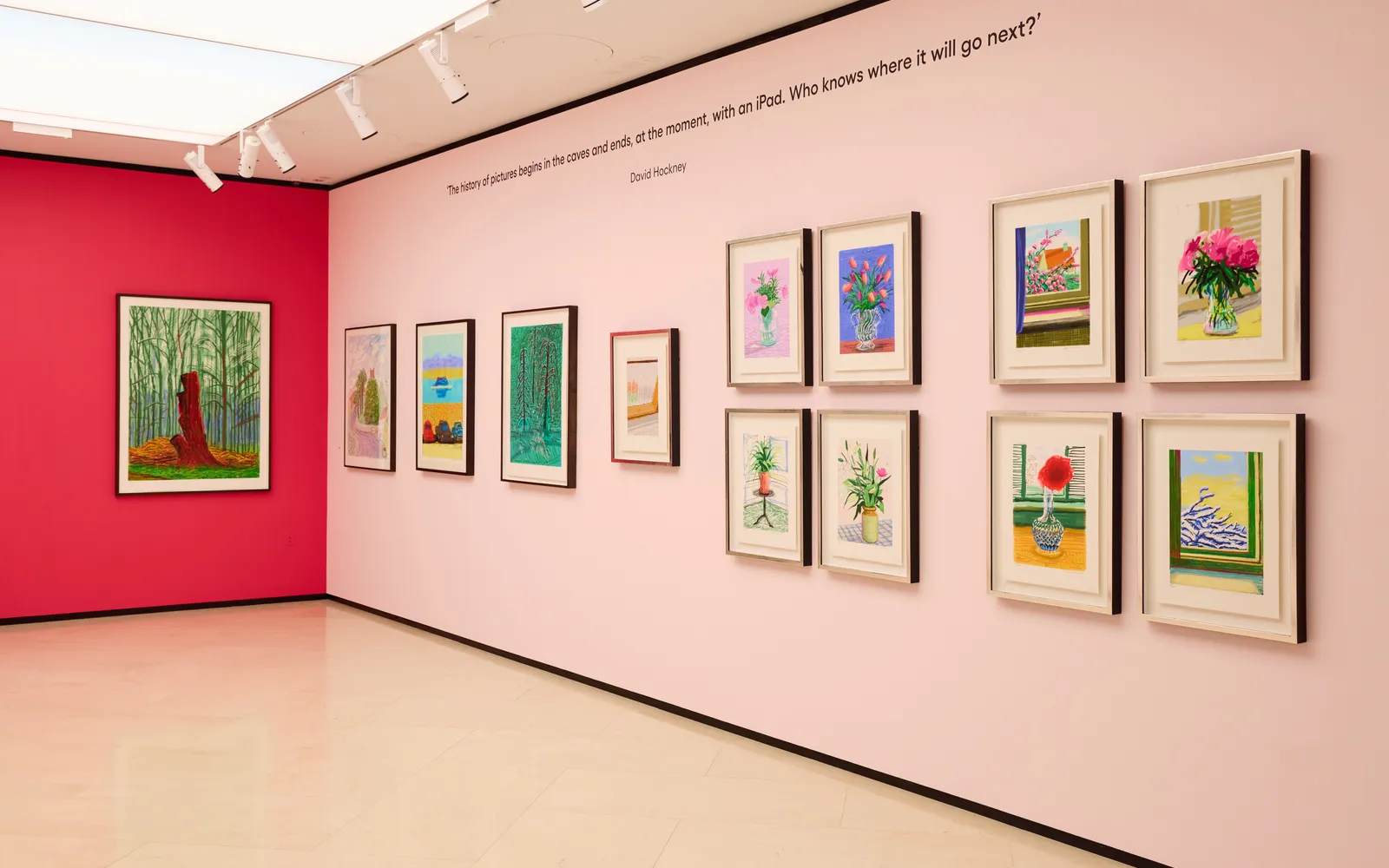
‘I know the views, I know the trees, I know them in winter, I’ve known them in summer, I’ve known them with their autumn leaves on. Each one, because that’s all I’m doing, looking at them.’
David Hockney
New Perspectives
David Hockney
Slow Rise, 1993
Lithograph and screenprint on paper
63.5 x 77.5 cm

New Perspectives

In his landscapes, Hockney flattens the picture plane and investigates alternatives to single-point perspective. Rather than guiding the viewer’s eye towards a traditional vanishing point, he encourages a continually remaining gaze. Just as the landscape that he sat down to draw was living and breathing, our eyes move across the surface of his images, noticing textures, colours and relationships between forms, never once settling on any particular element.

Alongside A Year in Normandie, the Serpentine presents a series of brand new still life paintings, including Abstraction Resting on a Red and White Checkered Tablecloth. These works extend Hockney’s long-standing interest in perspective and abstraction and reflect his belief that ‘everything on a flat surface is an abstraction.’ Within this series of still life paintings, he experiments with a range of visual languages, deploying impasto and sweeping squeegee marks to create flattened but sculptural abstractions. These works challenge conventional perspective and encourage viewers to reflect on the act of seeing. The table surface itself, with its impossible perspective, functions almost like a stage, where colour, pattern and materiality coexist in shifting spatial relationships.

These recent abstractions resonate deeply with earlier moments in Hockney’s career, particularly in works from the 1990s, such as Slow Rise (1993). Created during a period when the artist was increasingly exploring abstraction in his work, Slow Rise uses layered forms and vibrant colour to generate a sense of rhythmic movement across the picture plane. Inspired heavily by Cubism, rather than depicting a recognisable landscape, the composition unfolds through overlapping shapes that guide the viewer’s gaze upwards through the image. The new tablecloth paintings share this concern with movement and spatial ambiguity. Although grounded in the still-life tradition, their interplay of pattern, colour and gesture dissolves the boundary between representation and abstraction. Seen in this context, the paintings suggest a continuity between Hockney’s earlier experiments with lithography and his more recent landscapes and abstract still lifes, examining how colour and form can create dynamic visual spaces that invite the viewer to move through the image rather than simply look at it.

DAVID HOCKNEY

DAVID HOCKNEY

    Atmospheric image Atmospheric image
    Atmospheric image Atmospheric image
    Atmospheric image Atmospheric image
    Atmospheric image Atmospheric image