David Hockney at the Serpentine Looking Back to Look Forward David Hockney at the Serpentine Looking Back to Look Forward

David Hockney at the Serpentine

Looking Back to Look Forward
/

Over the course of a seven-decade career, David Hockney has consistently redefined his artistic practice. His creativity has long been shaped by a sustained engagement with art history, drawing on a wide range of visual traditions to extend and enrich his own practice. In Hockney’s recent exhibition at the Serpentine Gallery, David Hockney: A Year in Normandie and Some Other Thoughts About Painting, a new body of work brings his dialogue with other artists into renewed focus.

The Serpentine exhibition showcases ten new canvases by Hockney: five still lifes and five portraits of figures from Hockney’s immediate circle, including family members and carers. These works are linked by a shared frontal composition and by the repeated presence of a gingham tablecloth inspired by the cafes of Normandy, which serves as the ground for each arrangement. The still lifes in this exhibition represent a novel approach to the genre's conventions for the artist. Hockney chooses to depart from traditional still life objects such as fruit and flowers found elsewhere in his oeuvre. Instead, the artist places canvas-shaped ‘abstracts’ within the pictorial field. Arguably, all of these ‘abstracts’ are representative of an artwork, with two of the five still lifes making explicit reference to the work of Mark Rothko and Gerhard Richter.

If you are interested in adding to your collection speak to an art consultant today - info@halcyongallery.com

In Another Abstraction Resting on a Blue and White Checkered Tablecloth, an expressive colour field canvas is positioned on the...
David Hockney
Sparer Chairs, 2014
Photographic drawing in colours, printed on wove paper, the full sheet mounted to Dibond
108 x 176.5 cm

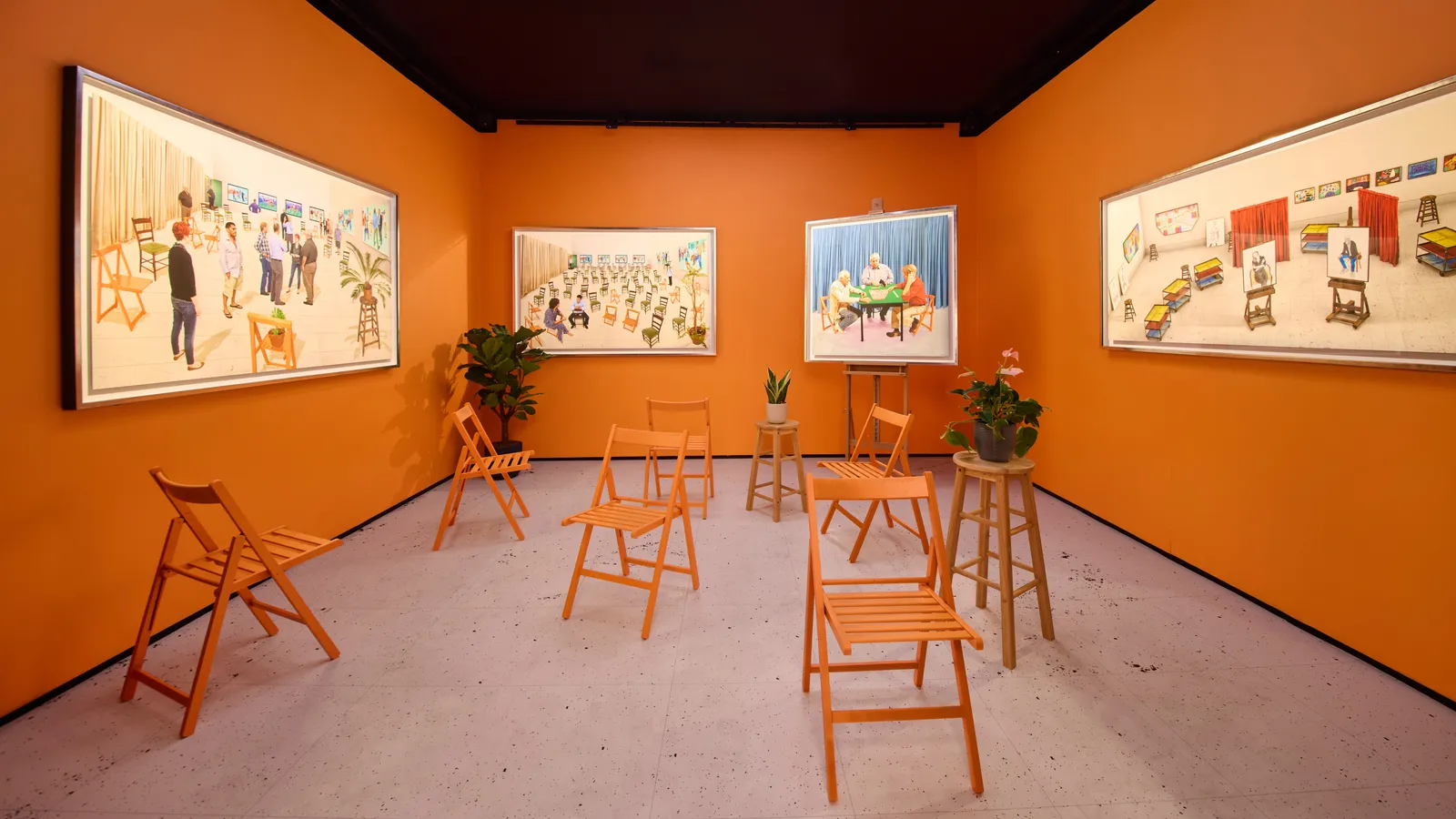
In Another Abstraction Resting on a Blue and White Checkered Tablecloth, an expressive colour field canvas is positioned on the table. Its large bands of flat colours – red, black, and orange – are immediately suggestive of the work of Mark Rothko. Likewise, in Abstraction Resting on a Grey and White Checkered Tablecloth, a canvas with dragged, squeegee-like marks recalls the visual language of a Gerhard Richter painting. This body of works marks a departure from earlier examples in which works of art appear in more conventional terms, mounted on walls or easels. In works such as Sparer Chairs (2014), and Tyler Dining Room (1985), for example, artworks remain fixed within the interior and behave within the pictorial space as artworks should. In the Serpentine paintings, by contrast, they are positioned quite dominantly within the composition, commanding the viewer’s attention.  Curiously, Hockney approaches the titling of these works in a uniform manner. By naming each work a variation of ‘Abstraction Resting on a Checkered Tablecloth’, Hockney avoids distinguishing one ‘abstract’ from another. The painting within the painting is not identified by artist, style, or subject, but reduced to the generic description of ‘abstraction’ regardless of whether it is readily recognisable as a work of another artist, such as Rothko or Richter.

‘There’s no such thing as a copy really. Everything is a translation of something else.’
David Hockney
Both Richter and Rothko’s work is situated within the field of abstraction. Rothko (American, 1903–70), who was associated with the...
David Hockney
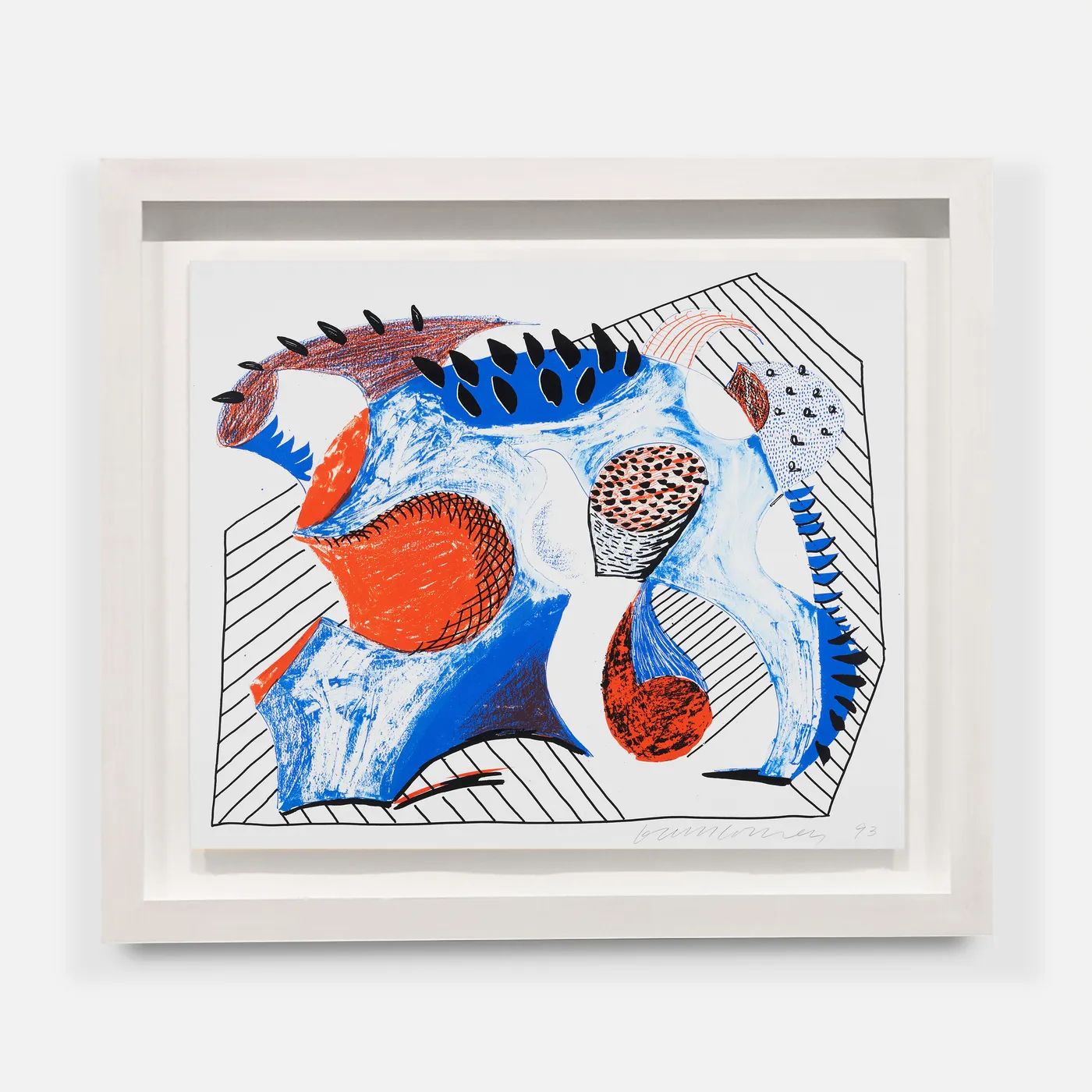
Untitled (For Joel Wachs), 1993
Lithograph and Screenprint
78 x 88 cm

Both Richter and Rothko’s work is situated within the field of abstraction. Rothko (American, 1903–70), who was associated with the American school of Abstract Expressionism, is best known for his colour field canvases which consist of colourful rectangular forms. Richter (German, b. 1932), is one of the most influential artists of his generation, whose career is defined by the wide-ranging exploration of how painting can exist between abstraction and photorealism.  Hockney’s employment of such recognisable painterly motifs within the Serpentine paintings is hardly surprising.  His engagement with abstraction began early: in 1958, he travelled to London to see the first exhibition of Jackson Pollock’s work in Britain at the Whitechapel Art Gallery. Yet while he dabbled in abstraction during his studies at the Royal College of Art, he chose to distinguish himself from many of his contemporaries by turning away from the Abstract Expressionism and returning to the figure. Later, in the 1990s, his growing disillusionment with naturalism, together with the success of the Moving Focus series and his experimentation with Cubist techniques throughout the 1980s, informed a renewed shift towards abstraction. His lithographs of the following decade exemplify this development, such as Untitled (For Joel Wachs).

In the three-remaining still lifes within the Serpentine exhibition, Hockney turns to motifs drawn from his own practice. In Abstraction...
David Hockney
Above and Beyond, 1993
Screenprint in colours on Arches wove paper
79 x 102 cm
In the three-remaining still lifes within the Serpentine exhibition, Hockney turns to motifs drawn from his own practice. In Abstraction Resting on a Red and White Checkered Tablecloth, the ‘abstract’ within the painting directly references his 1993 screenprint, Above and Beyond. In the other two paintings, the references are less explicit but still legible in relation to recurring formal devices within his oeuvre. The loose and bold linework of Abstraction Resting on a Green and White Checkered Tablecloth, for instance, evokes Hockney’s mark-making in his long-standing treatment of water, particularly in his representations of pools. However, the abstract form in Abstraction Resting on a Blue and White Checkered Tablecloth is more ambiguous in nature. Here, Hockney fuses colour and shape to create an abstract mass.  The boundaries of this abstraction are arguably less defined than the other four, and in turn disrupts the viewer’s understanding of what we are looking at in this artwork. Such disruptions in traditional forms of representation are not a new approach for Hockney. It is, in fact, a device Hockney has employed throughout his oeuvre and has borrowed from art historical traditions for inspiration. 
‘I want to use different styles, or a vocabulary of styles…I think it is part of the technique of painting to be able to adapt yourself to different styles; Picasso can. He knows, I am sure, the real meaning of style, and what can be done with it.’
David Hockney
Hockney’s Serpentine paintings extend his lifelong fascination with the act of looking, demonstrated in works such as the aforementioned Moving...
David Hockney
Artist and Model, 1974
Etching on Arches paper
75.6 x 56.5 cm

Hockney’s Serpentine paintings extend his lifelong fascination with the act of looking, demonstrated in works such as the aforementioned Moving Focus series. In this body of work, we encounter Hockney’s examination of perspective, inspired by Renaissance fixed-viewpoint paintings and principles of Chinese scroll painting. The influence of Cubism and Pablo Picasso is particularly evident in the portraits of the series which provide a dynamic record of the sitter over a period of time. Picasso had a lasting impact on Hockney and has consistently identified the artist as a guiding force, crediting him with revealing new ways of structuring pictorial space and representing a lived experience. Picasso’s capacity to fracture, reassemble, and animate form enabled Hockney to envision alternatives to single-point perspective, allowing the image to reflect the movement of the eye and the temporality of perception itself. Remnants of Picasso’s enduring influence on Hockney are evident in the Serpentine paintings, which reflect the artist’s continuous exploration of alternatives to single-point perspective.

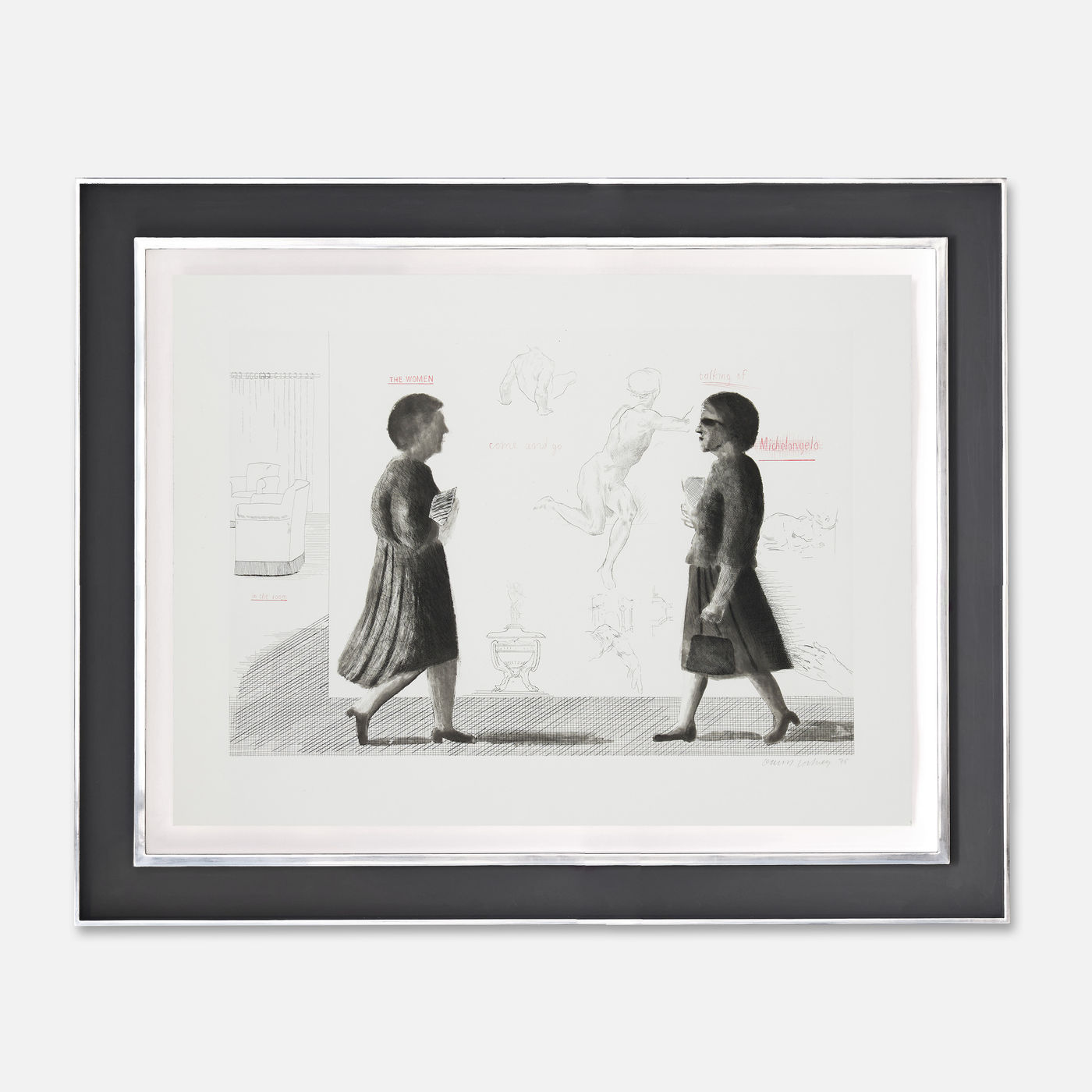
Hockney has directly referenced Picasso in works such as Artist and Model (1974), where he seats himself across from the Spanish master in an imaginary meeting, as well as in The Blue Guitar portfolio (1976 – 77), which borrows imagery as well as the tonal and emotional qualities from Picasso’s Blue Period. Elsewhere in works such as Homage to Michelangelo (1975), Hockney utilises motifs of another artist. In this example, Hockney adapts imagery that visually echoes the preparatory drawings of Renaissance master, Michelangelo.

Throughout Hockney’s career, we see a sustained engagement with art-historical traditions, which is arguably most monumentally realised in his work...
David Hockney
Homage to Michelangelo, 1975
Etching, soft-ground etching and aquatint on paper
59.5 x 79.5 cm

Throughout Hockney’s career, we see a sustained engagement with art-historical traditions, which is arguably most monumentally realised in his work A Year in Normandie (2020-2021), on display at the Serpentine. This ninety-metre-long frieze, inspired by Chinese scroll paintings and the eleventh-century Bayeux Tapestry, encapsulates Hockney’s enduring ability to transform art-historical traditions into uniquely imaginative works of art. In turn, the still life paintings in the Serpentine exhibition may be understood as part of a longer lineage within Hockney’s practice, one in which he repeatedly engages with the work of other artists and adapts their creative innovations to extend and enrich his own practice.

If you are interested in adding to your collection speak to an art consultant today - info@halcyongallery.com

DAVID HOCKNEY 29 New Bond Street

DAVID HOCKNEY

29 New Bond Street
    Atmospheric image Atmospheric image
    Atmospheric image Atmospheric image
    Atmospheric image Atmospheric image
    Atmospheric image Atmospheric image