Hockney & Paricio Pools Hockney & Paricio Pools

Hockney & Paricio

Pools
/

David Hockney’s iconic representations of swimming pools are some of the most memorable artworks of the 20th century. His depictions of California in the 1960s and 1970s cemented the swimming pool as a symbol of modern leisure and freedom.

Pedro Paricio is an artist who draws inspiration from art history, reinventing familiar motifs in his unique visual language. Paricio is acutely aware of the surrounding world, its environment, history and traditions. Subsequently, his work holds a mirror to his ability to absorb, distil and create. Throughout his oeuvre, an unbridled and unfearful devotion to colour reigns, and this is certainly true in Paricio’s joyful paintings of Hockney-esque pools in Halcyon’s current exhibition 

Hockney / Paricio: Cycles of Renewal.

‘I never thought the swimming pool pictures were at all about mere hedonist pleasure … They were about the surface of the water, the very thin film, the shimmering two-dimensionality … it’s that surface that fascinates me; and that’s what those paintings are about really.’
David Hockney
Colour and Light
Pedro Paricio
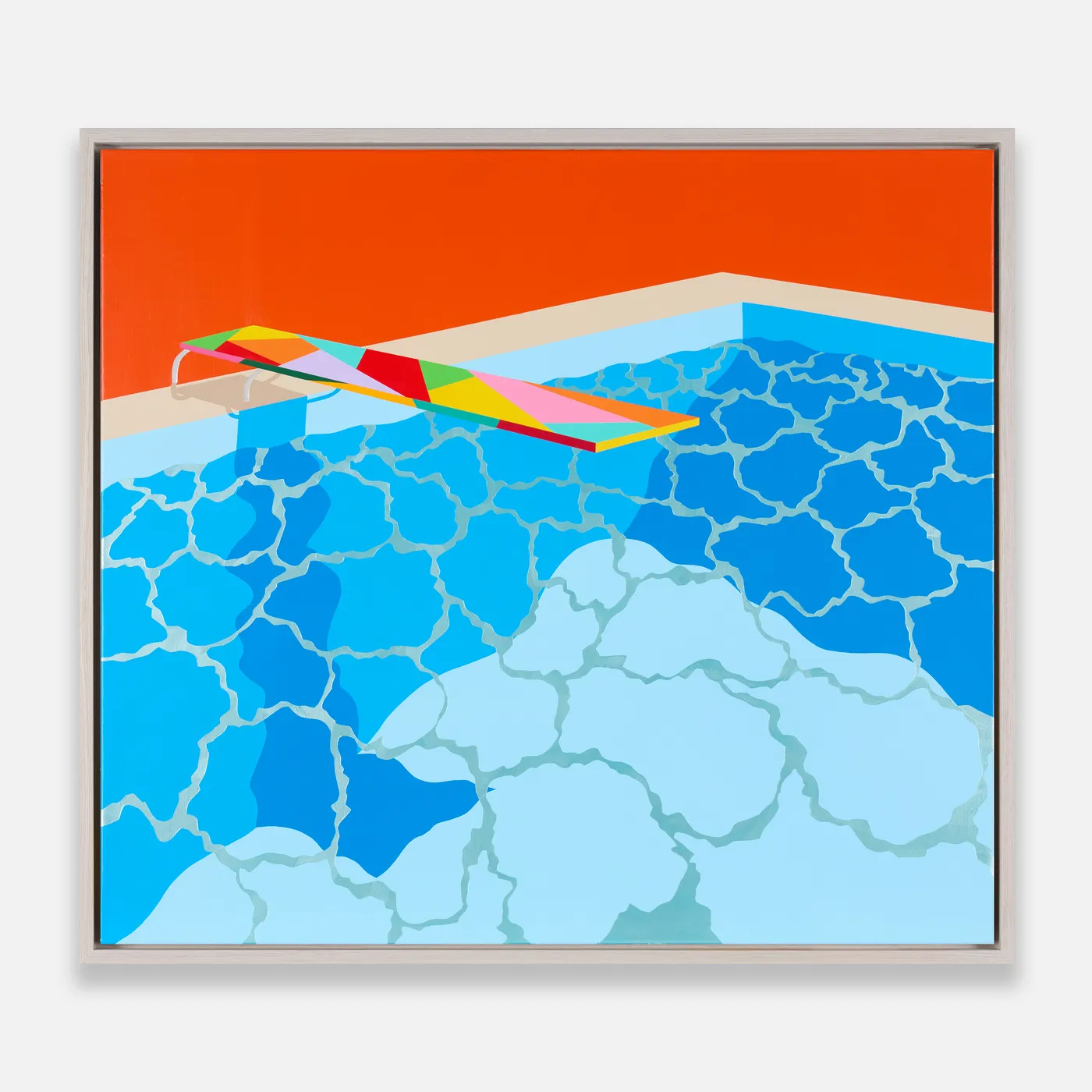
Pool Orange, 2025
Acrylic on linen
89.3 x 100 cm

Colour and Light

When considering the history of modern art, Hockney emerges as a figure virtually synonymous with the motif of the swimming pool. Arriving in Los Angeles in 1964, the sun-drenched affluence of California differed sharply from Hockney’s hometown of Bradford in West Yorkshire. He originally travelled there with the intention of staying for six months but ended up settling there, buying a house in the hills. The brilliance of the Californian light and the intensity of its colours permeated his subsequent paintings. ‘Whenever I left England, colours got stronger in the pictures’, Hockney explained. ‘California always affected me with colour. Because of the light you see more colour… there is more colour in life here.’

In a similar vein, Paricio channels the luminous palette and sunlit terrain of his native Tenerife into his vibrant paintings, often revisiting and reconfiguring the same image in various colourways. In his Pool series, Paricio dives headfirst into one of the most iconic motifs of 20th century art history. Dazzling reflections dance across the water in Hockney fashion, their fluidity standing in contrast to the rigid, flat blocks of colour found throughout the canvas. The repetition of a striking image in different colourways evokes the seriality of Pop Art, explored by Warhol in his portraits and portfolios of everyday objects. In his Pool paintings, Paricio juxtaposes vivid blues and cool, metallic tones with backgrounds of warm orange, yellow, pink and red, amplifying the feeling of leisure and playfulness that defines a poolside environment. A particularly striking feature is the vacant diving board, rendered in bold geometric patterns which draw the viewer’s attention to the conspicuous absence of human figures. This device echoes the composition of Hockney’s pool paintings of the 1960s and 1970s, in which the diving board symbolises a moment of tension, signalling the potential for action and disruption of what Hockney describes as ‘the surface of the water, the very thin film, the shimmering two-dimensionality.’

‘Water in swimming pools changes its look more than in any other form. The colour of a river is related to the sky it reflects, and the sea always seems to me to be the same colour and have the same dancing patterns. But the look of swimming-pool water is controllable – even its colour can be man-made – and its dancing rhythms reflect not only the sky but, because of its transparency, the depth of the water as well. So I had to use techniques to represent this.’
David Hockney
Dancing Lines
David Hockney
Pool made with Paper and Blue Ink for Book, 1980
Lithograph in colour on Arches cover paper
64 x 56 cm

Dancing Lines

Hockney’s lithograph Pool made with Paper and Blue Ink for Book, created in 1980, shows a closely cropped image of a diving board overhanging a vibrant blue swimming pool. The surface of the water shimmers and glistens in the daylight, the sun casting a rippling shadow from the board across the water’s edge. The depth of the pool is suggested through the cross-hatching of darker blue lines, which change direction to imply the bottom of the pool. Meanwhile, broader undulating lines cover the entire surface, suggesting the gentle rippling and movement of the water.

In his pool paintings and lithographs, Hockney engages with the technical challenge of capturing a body of water in motion. As the artist reflected, ‘In the swimming pool pictures, I had become interested in the more general problem of painting the water, finding a way to do it.’ The mutability of water, with its perpetually changing colours, forms and varying levels of transparency, became a graphic challenge for Hockney. He described the dynamic ripples on the surface of water as ‘dancing lines.’ This mark-making may possibly reveal that the pool depicted is, in fact, from Hockney’s own residence at the time, in Montcalm Ave, Los Angeles. In 1979 the artist moved into the property and went about decorating the pool with distinctive semi-circular blue marks similar to those seen in Pool made with Paper and Blue Ink for Book. The close date between the artist arriving at his new residence and the execution of this lithograph, separated by just one year, makes this possibility even more palpable. In a similar manner, Paricio’s approach to painting water captures the motion and fluidity of a swimming pool, albeit using different techniques to Hockney. In his Pool paintings, Paricio applies metallic paint to capture the shimmering ripples on the water’s surface. Visually, this marks a departure from Hockney’s curvilinear ‘dancing lines’, but the striking juxtaposition between straight lines and fluctuating ripples remains.
‘To live and die with, for, and through painting – for the need to paint, which is the need to represent the world and to represent ourselves within it… And this commitment need not be understood in a tragic way, but rather with joy and enthusiasm, which is one of the great lessons Hockney has given us throughout his life.’
Pedro Paricio
Portrait of an Artist
Pedro Paricio
Pool with Two Figures on a Landscape, 2025
Acrylic on linen
195 x 342 cm ( each 195 x 144 cm )

Portrait of an Artist

Paricio has remarked that all of Hockney’s art ‘can be understood as a kind of diary, because if every work is autobiographical – implicitly or explicitly – Hockney’s is a complete logbook, encompassing his travels, his passions, and his loves.’ This notion elucidates Paricio’s engagement with Hockney’s paintings, particularly his reimagining of the seminal 1972 work, Portrait of an Artist (Pool with Two Figures). The original painting was in fact an entirely fabricated and imagined scene assembled from various photographic sources. Reflecting on his painting, Hockney noted: ‘The figures never related to one another, nor to the background. I changed the setting constantly from distant mountains to a claustrophobic wall and back again to mountains.’ While Hockney’s painting is already a carefully constructed composite image, Paricio extends this process of reinvention. Paricio’s Pool with Two Figures on a Landscape (2025) reimagines Hockney’s iconic painting through his own biography and visual language.

The protagonists of Hockney’s Portrait of an Artist (Pool with Two Figures) are his former partner Peter Schlesinger, who stands fully clothed on the edge of the swimming pool, looking down at an anonymous swimmer submerged beneath the water’s surface. The relationship between these figures is deliberately ambiguous, and the visual separation is clear in the composition. Paricio preserves this sense of disjunction: in his version, the standing figure is reimagined as a woman, her arm extended towards the water in a gesture that implies yearning for connection, in contrast to the passive stance of Hockney’s figure. Both the woman and the swimmer’s body are rendered in Paricio’s signature kaleidoscopic patterns, dissolving the figures into abstraction and obscuring their identities. Paricio’s flattened, two-dimensional style is particularly suited to depicting a refracted body beneath the water’s surface, heightening the visual distortions already present in Hockney’s original painting. The relationship between the two protagonists remains unresolved: the swimmer is suspended between motion and stillness, raising questions about whether they are floating, swimming, or drowning.

Another point of departure in Paricio’s Pool with Two Figures on a Landscape is the reworking of the image into a monumental triptych, introducing a sense of visual seriality. The format invites the viewer to read the scene as an unfolding narrative, while simultaneously referencing Hockney’s other paintings which span multiple canvases or are formed of composite images. Paricio also infuses elements of his own biography into the landscape of the scene. The vegetation which frames the pool evokes the subtropical plants of his native Tenerife, rendered with visible, expressive brushstrokes that contrast with the rigid geometry of the figures and the pool itself. The setting is deliberately ambiguous – it could be California, the south of France (which was the location of the photographic source for Hockney’s painting) or the volcanic terrain of Tenerife and the Canary Islands.
Cycles of Renewal David Hockney | Pedro Paricio

Cycles of Renewal

David Hockney | Pedro Paricio

Contact us

    Atmospheric image Atmospheric image
    Atmospheric image Atmospheric image
    Atmospheric image Atmospheric image
    Atmospheric image Atmospheric image